


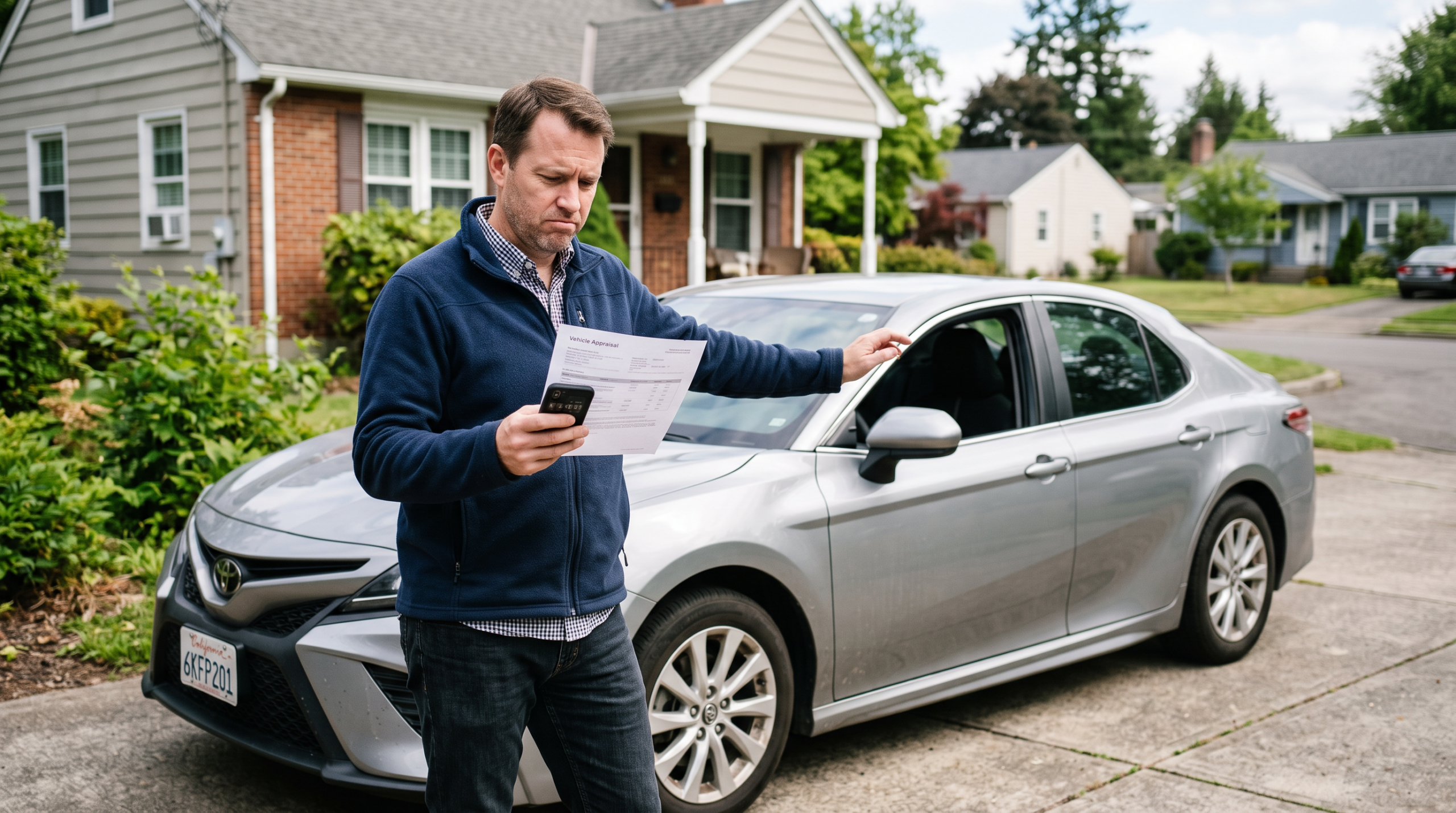
What is a lowball trade-in offer? It is a dealer quote that comes in well below your car’s actual wholesale value, usually because the dealer is padding margin, inflating the reconditioning costs they subtract, or assuming you will not check a second number. A low offer is not proof of a scam; it is one dealer’s opening position. The fix is to get competing offers so you can see where the real market sits.
A lowball trade-in offer is a dealer quote that comes in well below what your car is actually worth at wholesale. It usually happens for one of three reasons: the dealer is padding their margin, inflating the reconditioning costs they subtract from the offer, or betting you won’t get a second quote to compare against. Clairvo’s multi-offer platform helps sellers get 23% more for their car on average!
The offer itself is not proof of a scam. It is one dealer’s opening position on one day, shaped by how that store prices risk. The trouble is that most sellers only ever see one figure. Without a second quote, a low appraisal looks like the market rather than a single opinion. Understanding how a dealer reaches that number is what turns a lowball offer from a take-it-or-leave-it into a starting point you can move.
How a dealer actually values your trade-in
A trade-in appraisal starts with wholesale value, not the retail price you see on listings. Dealers work from auction and wholesale benchmarks such as Black Book or MMR, which track what cars like yours are actually selling for between dealers right now. That baseline is lower than retail because the dealer still has to recondition, market, and carry the car before anyone buys it. If you want the number the dealer is really working from, it helps to check a wholesale-oriented value before you go in.
From that wholesale baseline the store subtracts reconditioning: tires, brakes, cosmetic work, and anything a buyer would expect fixed. Then it factors demand and how fast the car is likely to turn. A model that sits on the lot for ninety days costs the dealer floor-plan interest every one of those days, so slow-selling cars get valued more conservatively. What is left after those deductions, minus the margin the store wants, becomes your offer.
What separates a fair offer from a lowball
A fair offer tracks close to wholesale after honest, itemized deductions. A lowball offer stretches those deductions or quietly anchors to a number well under wholesale and hopes you accept it.
The tell is the gap. A few hundred dollars below a clean wholesale benchmark is normal margin. A quote that comes in far under wholesale, with no clear explanation of why, is the one to question. A dealer who can walk you through the deductions is negotiating. A dealer who cannot is guessing that you will not ask.
Why the same car gets different offers
Two dealers can look at the identical car and quote hundreds of dollars apart, and both can be acting in good faith. One store may already have three of your model aging on the lot and price low to avoid a fourth. Another may be short on exactly your car and pay up to get it. Regional demand, current inventory, and aging risk all move the number. A single low offer is not a verdict on your car. It is one store’s math on one afternoon.
How to tell whether your offer is low
- Check a wholesale-oriented value first, not just the retail listings, so you know the number the dealer is really working from.
- Get at least one competing offer. A second and third quote turn an abstract question of fairness into a concrete range you can see.
- Ask the dealer to itemize the deductions. A fair appraisal survives that question.
This is exactly where comparing offers pays. Competing bids do not just raise the top offer. They show you, in dollars, where a lowball ends and a fair number begins.
Frequently asked questions
Is a lowball trade-in offer the same as a scam?
No. A lowball offer is a low but legitimate opening position. It becomes a problem only when a dealer refuses to explain how they got there or pressures you to sign before you can compare.
How much below market is considered a lowball?
There is no fixed line, but an offer noticeably under a clean wholesale benchmark, with no itemized reason for the gap, is a reasonable point to push back.
Can I negotiate a higher trade-in offer?
Often, yes. A documented wholesale value and one or two competing offers give you the leverage to move a low appraisal upward.
Does getting multiple offers actually help?
Yes. Multiple offers reveal the real range for your car instead of leaving you to judge a single number in isolation.
Know your number before you accept one
A lowball offer only works when it is the only number you have. See how much your car is really worth by letting dealers compete for it.


