

What does it actually cost to acquire a used car through auction, trade-in, or direct sourcing in 2026? On a true per-unit basis including fees, transport, and reconditioning, the three channels diverge more than most dealers realize. Auction is typically the most expensive, while trade-ins and direct-from-consumer sourcing usually come in lower. Knowing the real stack for each is what lets you shift toward the cheapest reliable source.
Most dealer principals can quote their average acquisition cost off the top of their head, but very few can give you a clean side-by-side of what auction, trade-in, and direct sourcing actually cost on a per-unit basis when you account for all the embedded expenses. The headline acquisition price is just the starting point. The complete cost includes buyer fees, transportation, reconditioning, time-to-list, and the carrying cost during whatever days-on-lot the unit ends up at.
This piece breaks down the true all-in cost of acquiring a vehicle through each of the three main channels in 2026. The numbers may not match what your store specifically sees, but the framework lets you do the math against your own data.
Free to evaluate. Compare your current per-unit acquisition cost against Clairvo direct-from-consumer.
The Complete Cost Stack for Used Car Acquisition
Every acquisition channel has the same underlying cost categories. The differences are in how much each category contributes and in some cases whether the category applies at all.
- Acquisition price: What you pay for the vehicle itself.
- Buyer fees: Auction-specific. Range from $250 to $700+ depending on the auction and the vehicle.
- Transportation: Cost to move the vehicle from acquisition point to your lot. Higher for distant auctions, zero for in-market direct.
- Reconditioning: Mechanical, cosmetic, and detail work to bring the vehicle to retail-ready. Varies by acquisition source and vehicle condition.
- Time-to-list: Days between acquisition and retail-ready. Each day delays revenue recognition and adds carrying cost.
- Carrying cost during days-on-lot: Floor plan interest, ongoing depreciation, reconditioning touch-ups. Our analysis of the true cost of aged inventory covers this in detail.
Channel 1: Auction Acquisition
The traditional acquisition channel for most franchise dealers. Auction supply is structurally constrained in 2026, which has driven both prices and total acquisition cost higher.
Per-Unit Cost Breakdown
On a representative $22,000 wholesale acquisition price for a 2021 midsize SUV:
- Acquisition price: $22,000
- Buyer fee: $400 (typical mid-range auction)
- Transportation: $300 to $600 depending on auction distance
- Reconditioning: $800 to $1,400 (auction units typically need more work than direct-from-consumer)
- Time-to-list: 8 to 12 days average
- Total all-in acquisition cost: $23,500 to $24,400
This represents the lowest base price but the highest combined ancillary costs. Auctions remain efficient at producing volume, but the cost-per-unit math has degraded as 2026 supply conditions have tightened.
When Auctions Make Sense
Despite the rising costs, auctions remain the most efficient way to acquire large volumes of inventory quickly when other channels cannot meet demand. They also remain the primary source for certain specialty vehicles (fleet returns, off-brand vehicles for independent lots, niche trim configurations) that simply do not show up in direct-from-consumer channels with any regularity. Our broader analysis of the off-lease shortfall covers why auction supply is constrained.
Channel 2: Trade-In Acquisition
Trade-ins remain the most operationally streamlined acquisition channel because they happen as part of a sale on the other side of the desk. The acquisition cost is partially offset by the gross on the new vehicle sale, which makes the per-unit math more complicated than the other channels.
Per-Unit Cost Breakdown
On the same representative vehicle ($22,000 ACV):
- Acquisition price: $20,000 (typically below ACV because trade-in offers price in the new vehicle gross)
- Buyer fee: $0
- Transportation: $0
- Reconditioning: $600 to $1,000 (variable based on vehicle history; better than auction average because you can see the vehicle and ask the customer about it)
- Time-to-list: 5 to 8 days average
- Total all-in acquisition cost: $20,600 to $21,000
Trade-ins look best in this math because of the lower base acquisition price, but the actual economics depend on the new vehicle gross. The discount to ACV is effectively a margin transfer between the two sides of the deal. Stores that account for trade-ins as standalone acquisitions miss this.
When Trade-Ins Are the Right Channel
Trade-ins are the right channel when you have a buyer for the new vehicle and the trade fits your retail inventory needs. They are not a strategy for filling inventory gaps because they only happen when a new vehicle sale is closing. Stores that try to use trade-ins as their primary used acquisition channel find that volume tracks new vehicle sales rather than used inventory needs.
Channel 3: Direct-From-Consumer Acquisition
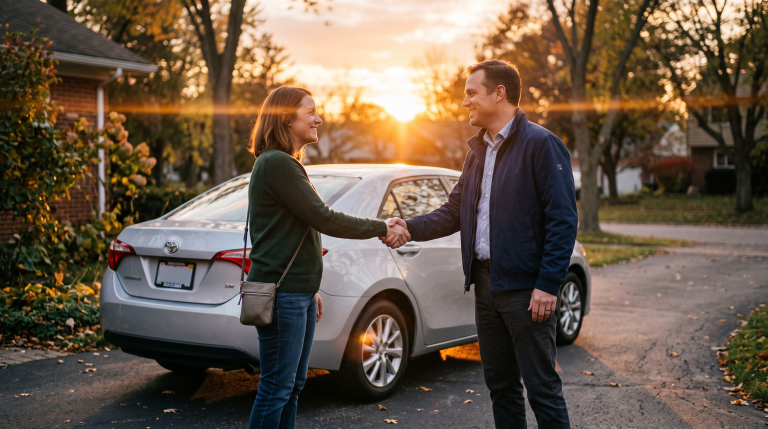
The fastest-growing channel in 2026 and the one where most independent and franchise stores have the most upside. Direct acquisition includes service drive sourcing, CRM equity mining, inbound consumer-direct leads, and multi-dealer platforms.
Per-Unit Cost Breakdown
On the same representative vehicle ($22,000 ACV):
- Acquisition price: $21,200 (typically pays above auction wholesale because you bypass auction inefficiencies and the consumer accepts a slight discount to private-party for the convenience)
- Buyer fee: $0 to $200 (some multi-dealer platforms charge a small per-acquisition fee; most do not)
- Transportation: $0 (in-market by definition)
- Reconditioning: $400 to $800 (direct-from-consumer vehicles typically have documented service history and need less work than auction units)
- Time-to-list: 4 to 7 days average
- Total all-in acquisition cost: $21,600 to $22,200
Direct acquisition typically lands between trade-in and auction on total cost while producing the cleanest inventory of the three channels. The lower reconditioning and faster time-to-list have downstream effects on carrying costs that compound through the lifecycle of the unit.
How Multi-Dealer Platforms Fit In
Multi-dealer platforms like Clairvo sit inside the direct-from-consumer channel. They route in-market consumer sellers to participating dealers who bid competitively. The dealer-side cost profile is similar to other direct channels but with the operational advantage of inbound flow: the platform delivers qualified sellers without the dealer needing to generate the leads.
Free to evaluate. Compare your current cost-per-unit against direct-from-consumer through Clairvo.
Side-by-Side Comparison
On the same $22,000 ACV vehicle, the all-in acquisition cost stacks up as follows:
- Trade-In: $20,600 to $21,000 (with margin transfer from the new vehicle sale)
- Direct-From-Consumer: $21,600 to $22,200
- Auction: $23,500 to $24,400
The auction premium over direct acquisition runs $1,900 to $2,800 per unit. At a store doing 50 used car acquisitions per month, shifting 30 percent of volume from auction to direct represents $28,500 to $42,000 in monthly acquisition cost savings before factoring in the downstream benefits of faster time-to-list and shorter days-on-lot.
Why Most Stores Are Not Doing the Math
Three reasons most stores cannot quote these numbers cleanly off the top of their head:
- Cost categories live in different systems. Acquisition price is in the DMS. Reconditioning is in service. Carrying cost is in the floor plan reporting. Putting it all together requires manual analysis that most stores do quarterly at best.
- The trade-in math is genuinely complicated. Properly allocating the margin between the new and used sides of a trade transaction is more complex than most store-level reporting captures. Many stores effectively treat trade-ins as zero-cost acquisitions, which understates the actual cost.
- Direct-from-consumer is too new for most stores to have baseline data. Stores that have only run direct acquisition for a few months do not yet have enough volume to produce reliable cost averages. The numbers in this piece are industry medians; your specific numbers may vary by 10 to 20 percent in either direction.
Stores that build the cost-per-channel math into their monthly used car reporting find the acquisition mix decisions become substantially easier. The auction lane becomes the supplemental channel, direct becomes the primary, and trade-ins fill in when new vehicle sales support them.
Frequently Asked Questions
What is the typical all-in cost to buy a used car at auction in 2026?
On a representative $22,000 wholesale acquisition, the all-in cost including buyer fees, transportation, and reconditioning typically runs $23,500 to $24,400. This is roughly $1,900 to $2,800 above the cost of acquiring the same vehicle directly from a consumer in your market. The auction premium has widened in 2026 as supply has tightened and reconditioning costs have risen on lower-quality auction inventory.
Is direct-from-consumer sourcing actually cheaper than auctions for dealers?
Yes, in most cases. Direct acquisitions typically cost $1,500 to $2,500 less per unit than equivalent auction acquisitions when accounting for buyer fees, transportation, and reconditioning differences. The acquisition price itself is sometimes slightly higher than auction wholesale because you are paying the consumer directly, but the absence of auction-specific fees and the lower reconditioning costs more than offset the higher base price.
Should dealers stop buying at auction entirely?
No. Auctions remain efficient for high-volume acquisition and for specialty vehicles that do not show up in direct-from-consumer channels reliably. The shift most stores need to make is treating auction as a supplemental channel rather than the primary one. A healthy 2026 acquisition mix typically runs 40 to 60 percent direct-from-consumer, 20 to 30 percent trade-ins, and 20 to 30 percent auction.
How do multi-dealer platforms like Clairvo fit into acquisition cost analysis?
Multi-dealer platforms sit inside the direct-from-consumer channel. The dealer-side cost profile is similar to other direct channels (no buyer fees, no transportation, low reconditioning) with the added operational advantage of inbound flow. The platform delivers qualified consumer sellers to participating dealers, who bid competitively. There is typically no upfront cost or volume commitment, which makes the channel low-risk to test alongside existing sourcing.
To go beyond the comparison in this article, our dealership ROI calculator for vehicle acquisition lets you plug in your own numbers and model cost per unit across auction, trade-in, and direct sourcing side by side.
Dealers can also review current listings and requirements directly at dealerforesite.com before reaching out.
Reduce your all-in acquisition cost with direct-from-consumer inventory.